
More and more often, companies are faced with counterfeit products. These imitations do not only lead to drops in sales for the manufacturers of the original parts but also pose liability risks for distributors. For users, these counterfeit products can often even be life-threatening.
To raise awareness for this serious issue, LÜDECKE performed a quality comparison between an original LÜDECKE coupling (mortar coupling made of aluminium with malleable iron levers) and an imitation. This comparison clearly shows which criteria you can use to identify counterfeit products and how companies can protect themselves from these inferior products. The process described consists of 5 steps and serves as guideline to be able to perform comparing product checks within a defined quality process.
1. Optical Comparison
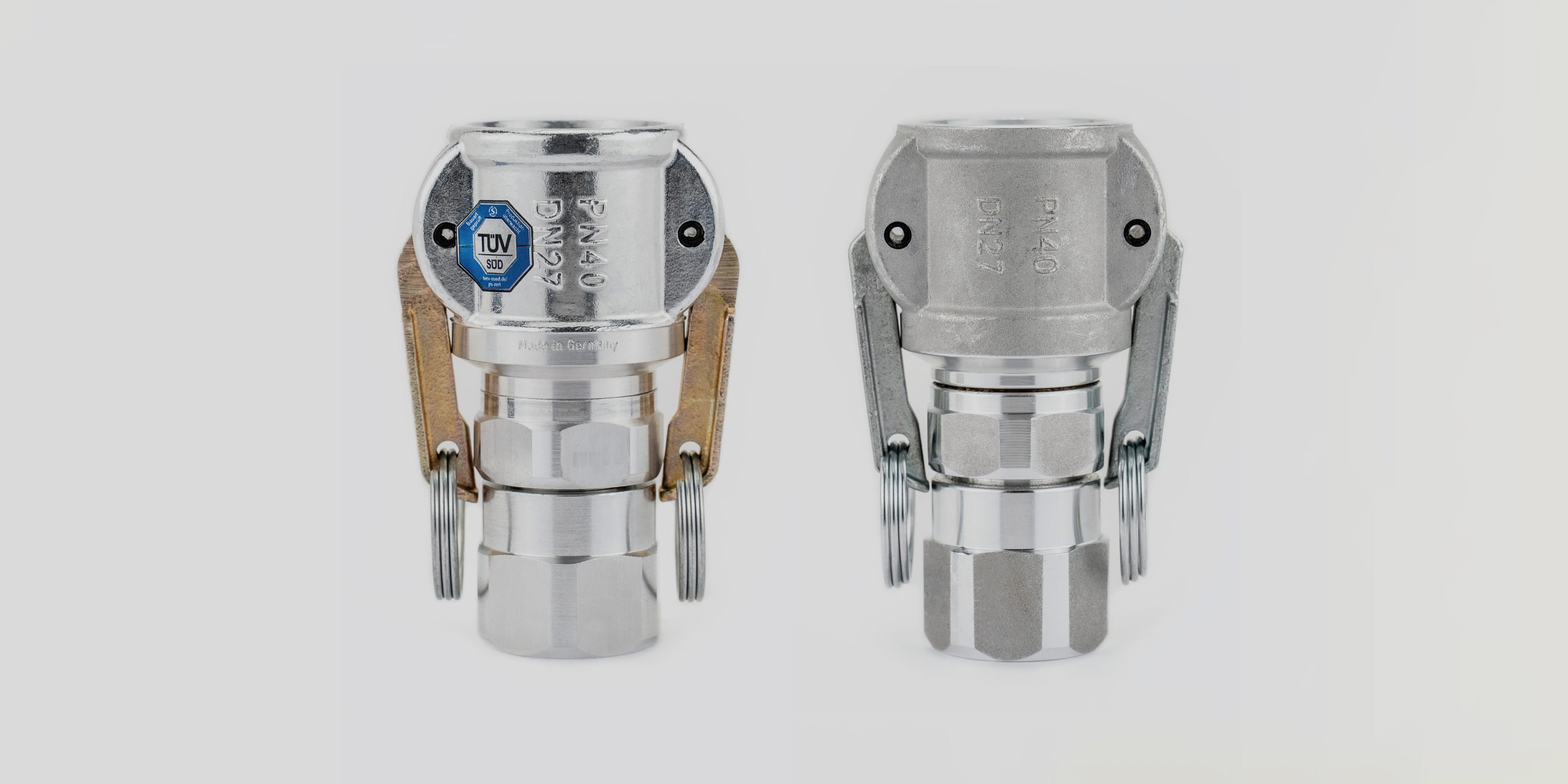
 Left: Original LÜDECKE coupling, right: counterfeit product | At first glance, counterfeit products are often very hard to tell apart from original parts. This is also true for this example. In a superficial and short comparison with the LÜDECKE coupling, the counterfeit product seems to be equipped with all necessary functions. Even the details concerning the pressure level and type size are in an identical position as in the original part. However, one important optical difference immediately strikes the eye: the counterfeit product does not bear the TÜV safety certificate sticker which indicates regular, strict internal quality checks. |
2. Tolerances / Material
 Stress marks on plug and lever | On close inspection, you can notice that the dimensions of the production and standard parts of the counterfeit product are not identical with the original coupling. This made the counterfeit product more difficult to use in the test: When coupling, you need more effort as the levers of the counterfeit product do only grip in the transition radius on the plug and not in the designated radius due to their imprecise dimensions. This impeded coupling process leads to visible stress marks on the plug (even if the robust original LÜDECKE plug is used). Due to this, the plug can no longer be used. Moreover, you can find stress marks on the levers which indicate that the material is too soft and inferior. |
3. Function
One important feature of the mortar coupling made of aluminium is its rotary function. It helps with constant swinging of the mostly rigid mortar pipes.
The original LÜDECKE coupling performs smoothly whereas in the counterfeit product you can feel a mechanical friction. It seems as if foreign objects are in the rotating area.
Please note: Iron variants for mortar coupling
 Blowhole in the hose barb | Using inferior materials often allows for the largest cut in costs for counterfeit products. This is for example true for iron materials. Counterfeit products often use chilled casting instead of malleable iron. Due to its high level of cementite, the material is hard, however also brittle and hence not suitable as construction material for strenuous applications. In high-class products the materialmalleable cast iron is used. This material is considerably more expensive when manufactured due to an additional annealing treatment. However, it shows improved properties and reliably withstands demanding and strongly dynamic loads as well as high forces. Counterfeit products can also be identified using so called blowholes. These are unwanted cavities or small holes in the inside of the material or on the surface. These blowholes are the result of errors in the manufacturing process and can have a negative effect on the function and quality of the product. |
4. Assembly / Disassembly
Also, when disassembling, the difference to the original product becomes clear. The basic body of the coupling is not flush glued to the nut which leads to adhesive leaking from the gap. Even after several weeks, the adhesive has still not hardened and has a viscous consistency.
Moreover, the inner thread is not true to gauge, and the threaded connection has a great radial backlash which can lead to leakages in the worst case.
5. Pressure Test
LÜDECKE has its own test laboratory which regularly performs material and binding tests. The pressure test bench allows for tests with couplings and pipes with up to 350 bar with different media and a temperature range from +20 to +80°C.

In this case, a static water pressure test has been performed with the counterfeit product – with a disappointing result:
Using a test pressure up to only 30 bar (which corresponds to everyday usage), the counterfeit product shows leakages. When using mortar, the material would settle in the leaks of the coupling, harden and make the coupling rigid over the course of time (possibly minimising the flow rate). After the test was nished, a major radial and axial backlash of the threaded connection could be found. Due to the occurring forces, the clamping levers were slightly deformed and thus the geometrical alignment changed. Eventually, this lead to a damaged plug.
Conclusion
This exemplary test result clearly shows that counterfeit products should not be used due to safety risks. Using inferior connection elements several times can lead to material failure with dire consequences. If an optical check reveals defects in the coupling system, usually the entire system needs to be changed.
Hints to identify Counterfeit Products:
- Missing certification labels
- Coupling and plug are hard to couple
- Blowholes
- Unmachined plane/cast surfaces
- Corrosion on zinc surfaces
- Dimensions of the same product of the same manufacturer differ from one another
- Significant stress marks on the coupling lever and plug after first use